The most challenging black runs on the Arlberg aren’t defined by steepness alone. They’re shaped by terrain, snow shifts, length, and how everything unfolds under your skis. This guide takes a closer look at the slopes that experienced skiers quietly respect, the ones that feel manageable at the top and very different halfway down.
Most Challenging Black Runs on the Arlberg
There’s a reason people keep talking about the most challenging black runs on the Arlberg long after their trip ends. It’s not just the gradient, and it’s definitely not just the label on the piste map. Something else is going on here.
You start a descent thinking it’s under control. The snow feels stable, your turns feel clean. Then the pitch tightens slightly. The surface changes. Your rhythm slips, not dramatically, just enough to notice. And that’s usually the moment when the Arlberg starts to show its character.
Across the broader Arlberg ski area, which stretches over 300 kilometres of terrain according to official regional data, there are plenty of black slopes. But only a handful really belong in the conversation when we talk about the most challenging black runs on the Arlberg. Those are the ones we’re focusing on here.
What Makes Black Slopes in the Arlberg So Demanding
At first glance, a black run suggests one thing: steep. And yes, gradient matters. But if that were the whole story, many other ski resorts would feel just as difficult. They don’t.
What stands out in the Arlberg ski resort is how multiple elements overlap at once. The terrain rarely feels uniform. A slope might begin wide and predictable, then narrow without warning. Wind exposure changes the surface, sometimes within a few turns. Groomed sections don’t always stay consistent, especially later in the day.
And then there’s length. Some runs in St. Anton keep going longer than you expect. That gradual build-up of effort, leg fatigue, and slight loss of precision becomes part of the difficulty.
Experienced skiers often underestimate that part. It’s not always the steepest section that catches you out. It’s what comes after.
Steepest Ski Runs in the Arlberg Compared to the World
It’s tempting to compare everything to extremes. People often ask what the steepest ski run in the world is, or which slope deserves the title of hardest ski run in the world. Names like the Streif in Kitzbühel or steep entries like Corbet’s Couloir tend to dominate those conversations.
And they should. The Streif, for example, reaches gradients of around 85%, according to data. That’s a different category altogether. But here’s where things shift.
The most challenging black runs on the Arlberg don’t rely on a single dramatic pitch. They stretch the difficulty across the entire descent. You don’t get a short, intense section followed by relief. Instead, you get sustained demand. A quick comparison makes that clearer:
| Run | Region | Maximum Gradient | What Makes It Hard |
| Streif (Kitzbühel downhill) | Austria | ~85% | Extreme race terrain |
| Corbet’s Couloir | USA | ~50° entry | Technical drop-in |
| Harakiri ski slope | Austria | 78% | Short, brutally steep |
| Arlberg black runs | Austria | 60–80% | Long, continuous challenge |
So while the Arlberg may not claim the steepest ski slope in the world, it offers something arguably more demanding over time.
Top 7 Hardest Runs in St. Anton and the Arlberg Ski Area
Let’s slow this down a bit and look at what actually matters on the mountain. Names alone don’t tell the full story. What makes the most challenging black runs on the Arlberg stand out is how each one behaves in real conditions, where it sits on the mountain, how steep it really feels under your skis, and what tends to catch people off guard.
1. Schindlerkar (St. Anton)
Schindlerkar (Skiroute 86) is often the first name locals mention when discussing the most challenging black runs on the Arlberg. It isn’t a conventional piste. Much of the terrain sits off-piste, which means conditions change quickly after snowfall or wind. The descent begins from the Schindlergrat area and drops into a steep, narrow basin where snow accumulates unevenly.
| Key Detail of Schindlerkar | Value |
| Max Gradient | ~78% |
| Terrain | Off-piste/ungroomed |
| Difficulty Factor | Avalanche exposure + narrow lines |
| Best Access | Schindlergrat lift |
What makes Schindlerkar difficult isn’t just steepness. It’s decision-making. Route choice matters, and that’s why local guidance is often recommended.
2. Mattun Run (St. Anton)
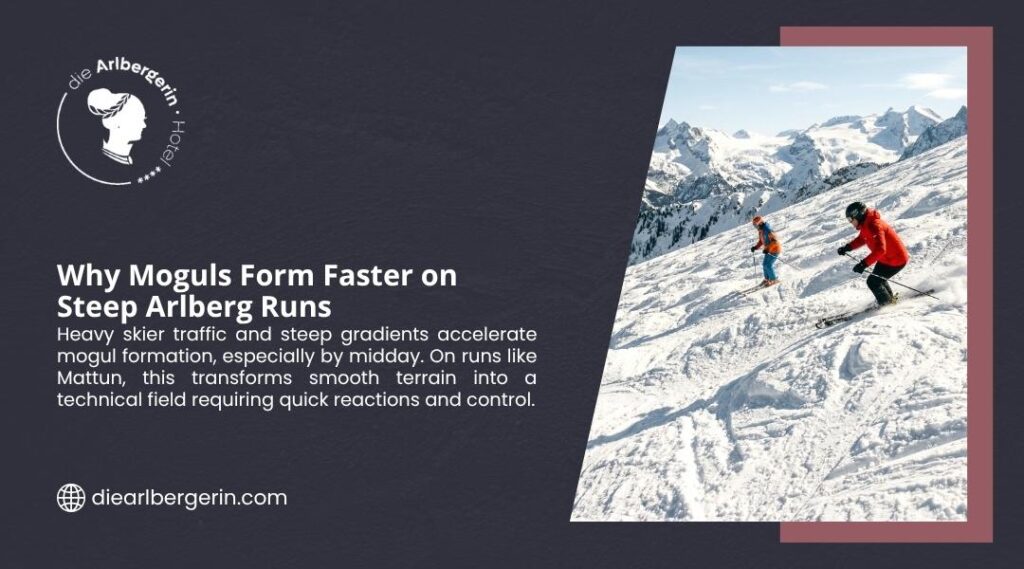
Mattun (Ski Route 40) feels different. It’s long, sustained, and doesn’t offer much relief. Once you commit, the slope keeps pushing. Unlike short steep pitches, Mattun forces skiers to maintain rhythm over distance.
| Key Detail of Mattun | Value |
| Official Name | Ski Route 40 (Mattun) |
| Length | ~3.1 km |
| Gradient | ~70% in steep sections |
| Terrain | Ungroomed (marked & secured only) |
| Difficulty Factor | High (Moguls/Off-piste skill required) |
This is where fatigue becomes part of the challenge. By the final section, even strong skiers begin to feel it.
3. Valluga North Face (St. Anton)
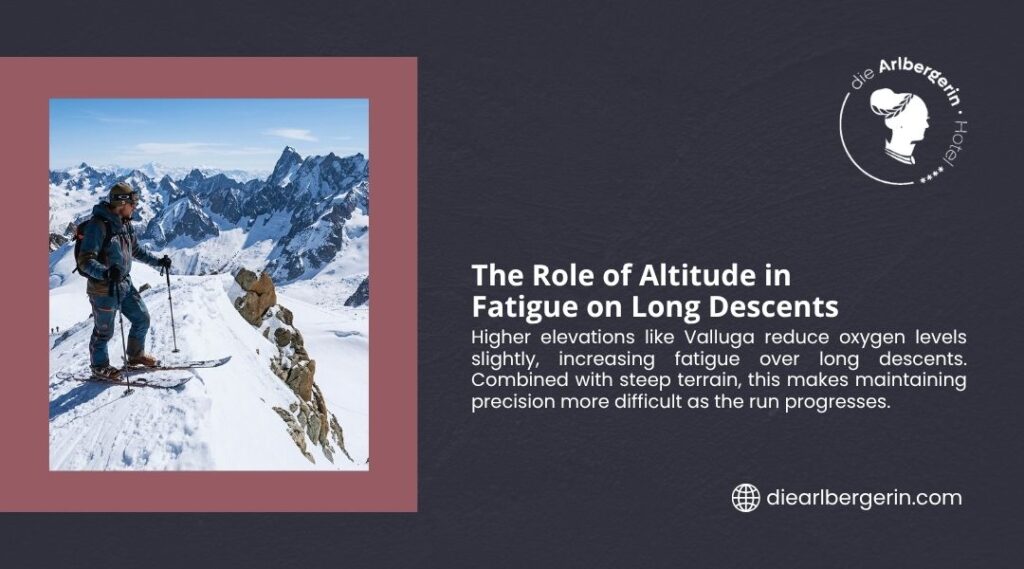
The Valluga North descent (also called Valluga) carries a reputation that extends beyond Austria. Access is restricted, and conditions dictate whether it’s even skiable. It’s widely regarded as one of the hardest ski runs in the world when conditions are firm.
The Valluga North Face sits at the highest point in the region, accessed via cable car. From the top, the terrain drops away more abruptly than most slopes in the Arlberg. It’s not just steep, it feels exposed.
| Key Detail of Valluga | Value |
| Gradient | 80%+ sections |
| Terrain | High alpine/extreme |
| Access | Guided recommended |
| Difficulty Factor | Exposure + steep entry |
Among the most challenging black runs on the Arlberg, this one stands apart because of the consequences. A mistake here carries more weight, not dramatic, but noticeable enough to change how you ski the entire descent.
4. Kandahar (St. Anton)
Kandahar isn’t wild like Schindlerkar. Instead, it reflects race heritage. The slope has hosted FIS Alpine World Cup races, which explains its consistent gradient, width, and technical layout designed for high-speed control rather than survival skiing.
| Key Detail | Value |
| Official Name | Kandahar (Garmisch-Partenkirchen) |
| Max Gradient | 92% (Freier Fall) |
| Terrain | Groomed race slope |
| Difficulty Factor | High-speed control + edge precision |
| Vertical Drop | ~920 m (top to valley via connected runs) |
| FIS Use | Yes (World Cup downhill & combined events) |
This is where advanced and expert skiers test clean carving, speed management, and line choice, especially on harder snow. Unlike freeride terrain, Kandahar punishes mistakes at speed rather than through exposure.
5. Hinter Rendl (St. Anton)
Hinter Rendl often surprises visitors. On calm days, it looks manageable. But wind exposure changes the surface quickly, turning it into one of the most challenging black runs on the Arlberg.
| Key Detail of Hinter Rendl | Value |
| Location | Rendl sector, St. Anton |
| Max Gradient | ~55–60% (sections) |
| Terrain | Groomed with variable snow |
| Difficulty Factor | Wind exposure + snow inconsistency |
| Aspect | South-facing (more sun impact) |
| Visibility | Can flatten contrast in bright light |
What makes Hinter Rendl tricky isn’t raw steepness. It’s how quickly the slope changes character. Morning corduroy can turn into softer patches or wind-affected sections within hours, requiring constant adjustment in technique.
6. Albona North (Stuben)
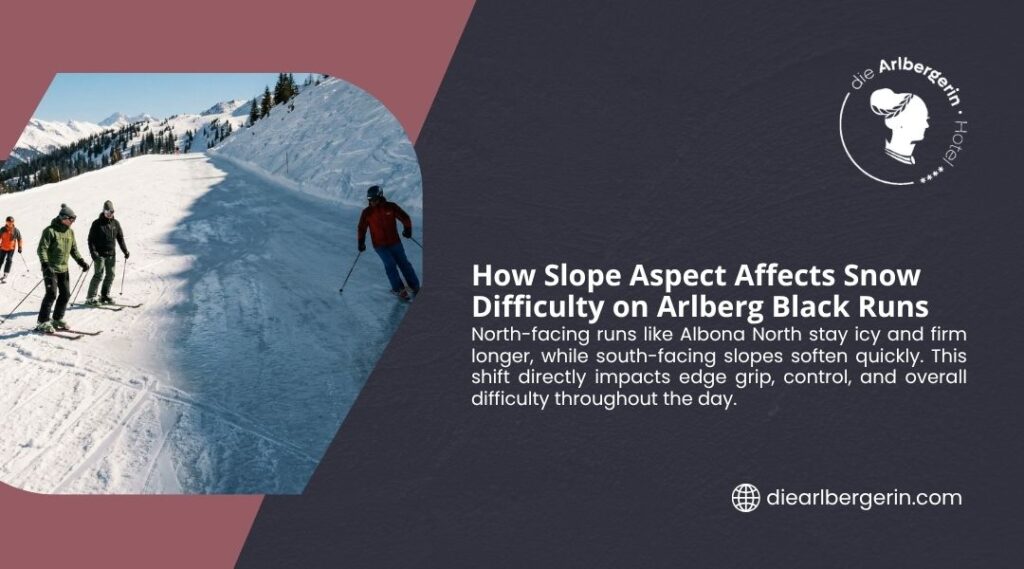
Albona North has a reputation among experienced skiers for its consistently firm surface and technical demands. Its north-facing orientation limits sun exposure, which helps preserve hard-packed snow and, at times, icy sections. Unlike steeper freeride terrain, the challenge here lies in maintaining edge grip and control on sustained pitches rather than navigating exposure.
| Key Detail of Albona North | Value |
| Location | Stuben (Albona sector) |
| Max Gradient | ~65–70% (steep sections, not continuous) |
| Terrain | Groomed upper sections + natural snow variability |
| Difficulty Factor | Hard-packed snow + edge precision |
| Snow Conditions | Often firm due to the north-facing slope |
| Skill Need | Advanced to expert carving technique |
7. Trittkopf Descent (Zürs)
Trittkopf isn’t defined by extreme steepness alone. Instead, it reflects the high-alpine transition terrain typical of the Zürs–Lech side of the Arlberg. The descent combines steep entry sections with flatter connecting pistes, which disrupts rhythm and demands constant adjustment in technique.
| Key Detail of Trittkopf | Value |
| Location | Zürs / Lech (Trittkopf sector) |
| Max Gradient | ~55–60% (short steep sections) |
| Terrain | Groomed + high-alpine transitions |
| Difficulty Factor | Terrain variation + visibility shifts |
| Altitude | Up to ~2,423 m (Trittkopf summit) |
| Exposure | Moderate to high (weather dependent) |
Unlike runs such as Schindlerkar, Trittkopf’s challenge comes from contrast rather than intensity. One moment demands controlled short turns on steeper pitches, the next requires speed management on flatter sections.
Technical Breakdown of the Toughest Runs
The following comparison highlights how the most challenging black runs on the Arlberg differ in structure and technical demand.
| Run | Gradient | Length | Terrain | Exposure |
| Schindlerkar | ~78% | Approx. 2 km | Off-piste | High |
| Mattun | ~70% | 3 km | Extreme Route | Medium |
| Valluga | 80%+ | Variable | Extreme | Very high |
| Kandahar | ~68% | 2.5 km | Black Piste | Medium |
| Albona North | ~70% | 2 km | Mixed | High |
These figures come from the public Ski Arlberg and Bergfex piste listings; where a clean official stat was not available, I’ve left it broad rather than inventing precision.
How the Arlberg Ski Area Challenges Even Experienced Skiers
The Arlberg ski area doesn’t rely on single standout slopes. It challenges skiers through consistency. Each run demands something slightly different. One descent tests balance, another forces edge precision, and the next introduces changing terrain underfoot.
That’s where many experienced skiers underestimate the region. It isn’t just about steep slope angles. It’s about how those slopes behave throughout the day. Temperature shifts harden surfaces. Wind redistributes snow. Visibility changes quickly at altitude.
That’s also why staying close to the lifts matters. A centrally located alpine base, such as comfortable rooms in St. Anton, allows early access before conditions deteriorate.
When Conditions Turn These Black Runs Into the Hardest Ski Slopes
The difficulty of the most challenging black runs on the Arlberg often depends on conditions rather than terrain alone.
| Condition | Impact on Difficulty | Runs Most Affected |
| Fresh Powder | Increased resistance | Schindlerkar, Valluga |
| Hard Ice | Reduced grip | Albona North, Kandahar |
| Wind | Uneven surface | Hinter Rendl |
| Low Visibility | Route confusion | Valluga, Trittkopf |
| Heavy Traffic | Mogul formation | Mattun |
These variables explain why the same slope can feel entirely different from one day to the next.
Skill Level and Run Selection
Matching ability with terrain reduces risk and improves overall experience.
| Skill Level | Recommended Runs | Key Focus | What to Expect |
| Advanced | Kandahar, Hinter Rendl | Technique | Controlled steep terrain |
| Advanced+ | Mattun, Albona North | Endurance | Longer, variable descents |
| Expert | Schindlerkar, Valluga | Full control | Technical, unpredictable |
Planning Your Stay Around the Arlberg Experience
Preparation doesn’t end with selecting ski runs. Logistics matter just as much. Easy access to lifts allows flexibility, especially when weather conditions shift.
Travel routes influence timing. Those arriving from Switzerland often plan their journey using Zurich to St. Anton travel options, while others coming from Germany typically rely on well-connected rail routes for a smooth trip.
Once in St. Anton, recovery becomes part of performance. Access to quality food and rest helps maintain energy across demanding days. A relaxed evening with traditional Tyrolean cuisine in St. Anton supports that balance.
For those travelling in groups, especially corporate ski trips, group activities in St. Anton add structure beyond skiing, with options that support team interaction and shared experiences both on and off the slopes.
Why the Arlberg Competes With the Hardest Ski Runs in the World
The Arlberg doesn’t rely on marketing claims. It earns its reputation through terrain diversity and consistency. While destinations such as the Kitzbühel downhill or Harakiri ski slope attract attention for steepness, the Arlberg delivers sustained challenge across multiple runs.
The question of what is the steepest ski run in the world often leads to headline numbers. But steepness alone doesn’t define difficulty. Terrain exposure, snow variation, and run length matter just as much.
That’s why many skiers consider the most challenging black runs on the Arlberg among the hardest ski runs in the world. It’s not a single descent. It’s the overall experience.
FAQs About the Most Challenging Black Runs on the Arlberg
Are the most challenging black runs on the Arlberg suitable for advanced skiers or only experts?
Some runs like Kandahar or Hinter Rendl suit strong advanced skiers, but routes such as Valluga require expert-level ability and experience with alpine terrain.
How does the Arlberg compare to the steepest ski run in the world?
The Arlberg may not hold the record for the steepest slope, but its terrain variety and changing conditions make it equally demanding.
When is the best time to ski difficult black runs in St. Anton?
Early morning often provides the most stable conditions before slopes become uneven or crowded.
Do black runs in the Arlberg stay groomed?
Some remain groomed, but many sections, especially expert routes, are left natural or partially maintained.
What makes the Arlberg ski area unique compared to other ski resorts?
The combination of scale, terrain diversity, and weather exposure creates a level of challenge rarely matched elsewhere.
Thinking About Taking Them On?
The most challenging black runs on the Arlberg don’t ask for perfection. They ask for attention, patience, and a bit of adaptability.
For skiers who enjoy that process, the small adjustments, the changing rhythm, this part of Austria offers something hard to replicate elsewhere.
If you’re planning a trip, it helps to stay somewhere that understands that balance between effort and recovery. A place that keeps things calm off the slopes, while keeping everything within reach.
You can explore options, seasonal offers, and availability directly through Die Arlbergerin, where the focus stays on exactly that kind of experience.
And once you’re here, standing at the top of one of these runs, the question usually shifts. Not whether it’s steep enough. But whether you’re ready for what comes next.