If you want the cleanest way into the Arlberg without winter road stress, how to get from Munich to St. Anton am Arlberg by train is a question worth answering properly. The route is straightforward, the scenery improves mile by mile, and the railway station in St. Anton sits close to the village core, which makes the last stretch much easier than many first-time visitors expect. The fastest services take a little over three hours, most itineraries call for one change, and advance fares can be far better than many travelers assume.
For most travelers, how to get from Munich to St. Anton am Arlberg by train comes down to one sensible plan: start at München Hauptbahnhof, book early through Deutsche Bahn or ÖBB, expect one change on most departures (typically in Kufstein or Innsbruck), and arrive in a village that is unusually rail-friendly by Alpine standards. St. Anton is an official Railjet stop, and its station is centrally placed for fast onward access to hotels and accommodation.
This article explains how to get from Munich to St. Anton am Arlberg by train, what route usually works best, which rail operators run it, what the journey feels like, and how to arrive in St. Anton more easily from the moment you step off the platform.
How to Get From Munich to St. Anton am Arlberg by Train
Here’s how it works. Most travelers leave from Munich Hbf, check the Deutsche Bahn fahrplan or the ÖBB Fahrplan, choose the fastest train that fits their day, and travel into western Austria with one connection along the way.
On most dates, there is no standard direct daytime train from Munich Hbf to St. Anton am Arlberg, so a transfer is part of the deal, not a red flag. The good news is that the route is routine, well served, and easy to book through Deutsche Bahn or ÖBB, the Austrian railways operator.
Travelers should note that the Arlberg Railway tunnel is a historic feat of engineering; you will pass through the Arlberg Tunnel, which was over 10.2 kilometers (10216 meters) long and the longest in Austria for more than a century after its 1884 opening. This tunnel connects Tyrol to Vorarlberg.
That matters because how to get from Munich to St. Anton am Arlberg by train is not really a mystery; the real issue is choosing the right departure. The fastest trains usually run at just over three hours, while slower options can stretch past four hours, especially on dates with less convenient connections. Rail planners often show a mix of DB and ÖBB services, including Railjet and other long-distance trains used within the Austrian rail network.
Route snapshot
| Metric | Details |
| Fastest journey time | 3h 03m to 3h 14m |
| Typical average time | about 3h 36m to 4h 30m |
| Rail distance | about 148 to 149 km |
| Typical frequency | about 7 to 21 trains per day |
| Standard transfer pattern | Usually 1 change (Most often at Innsbruck Hbf) |
| Main booking platforms | Deutsche Bahn, ÖBB, major rail retailers |
The range looks wide because not every planner counts trains in the same way, and not every departure is equally efficient. Still, the broad picture is consistent across sources: this is a short Alpine rail trip, not a full-day haul.
Munich to St. Anton train time, distance, and the usual route
The rail journey from Munich to St. Anton am Arlberg covers roughly 148 to 149 kilometers, depending on how the timetable source displays the route. Fast runs start a shade above the three-hour mark, while average travel times come in higher because connection quality varies throughout the day. That gap trips people up. They see one site promise speed, then another shows a much slower average. Both can be right.
Most routes from Munich Hbf follow a simple pattern. You board in Munich, head toward Austria, then change once before the last leg into St. Anton am Arlberg. In practice, many itineraries route through Kufstein or Innsbruck, while some planners can surface alternatives depending on time of day and rail works.
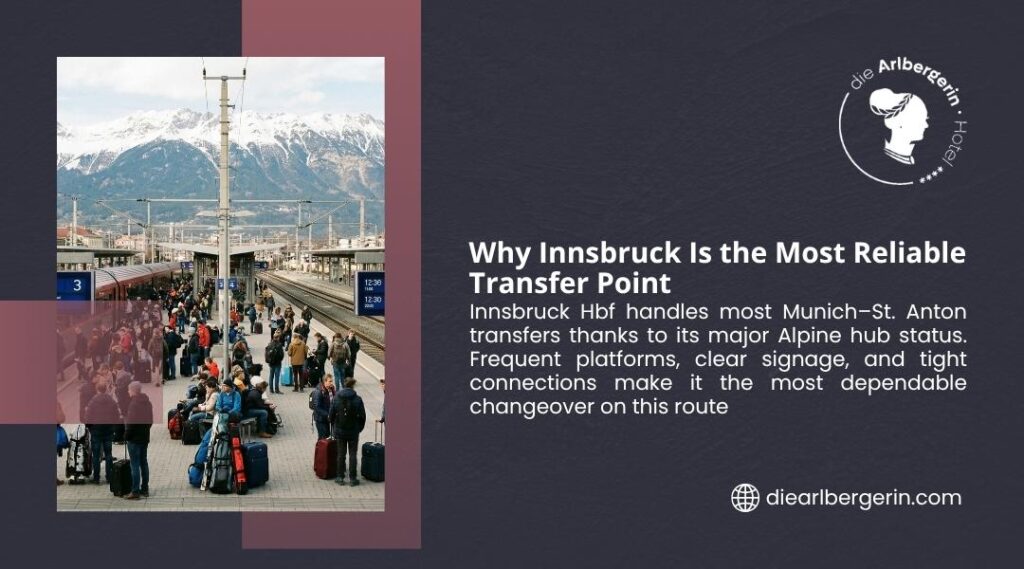
If your connection is in Innsbruck, you are transferring at one of the busiest hubs in the Alps, so keep an eye on the digital displays as platforms can sometimes change at the last minute. So, when travelers search for how to get from Munich to St. Anton am Arlberg by train, what they usually need is not a dramatic travel hack. They need reassurance that a one-change route is normal and easy to manage.
Which trains run on this route: Deutsche Bahn, ÖBB, Railjet, and other long-distance services
This route is usually a joint effort between German and Austrian rail networks, which is why travelers often see both Deutsche Bahn (DB) and ÖBB (Austrian Federal Railway) while planning the same trip.
In practice, that is helpful rather than confusing. It means strong cross-border coverage, broad ticket availability, and a route that sits on a major Alpine corridor rather than on a marginal local line.
ÖBB also places Railjet, ICE, EuroCity, and other long-distance services within its long-distance pricing system, which gives travelers a clearer idea of what type of service they are booking.
| Train or operator | Role on the route | Why it matters |
| Deutsche Bahn | Main booking and routing option from Munich | Good for departures from Germany and cross-border planning |
| ÖBB | Austrian rail operator | Important for fares, timetable checks, and onward Austrian connections |
| Railjet | Premium long-distance service in Austria | Relevant because St. Anton is an official Railjet station |
| ICE / EuroCity / other long-distance trains | May appear in mixed itineraries | Common on routes that combine German and Austrian services |
The traveler needs to know that a Munich departure may include DB on one leg and ÖBB on another, and that this is entirely normal. That makes the route easier to trust.
Is there a direct train from Munich to St. Anton am Arlberg?
Usually, no. The strongest recurring route pages state that there are no standard direct trains between Munich Hbf and St. Anton am Arlberg and that at least one change is normally required. While some specialized “Ski Express” trains run on peak Saturdays during the height of winter, these are rare and often require specialized booking separate from the main DB or ÖBB apps.
But here’s the problem: some travelers hear one change and assume trouble. On this route, it is ordinary. Rail planners handle it well, station signage is straightforward, and the overall travel time still lands in a range that is very competitive with driving, especially when roads are busy or snowy.
So when a traveler asks how to get from Munich to St. Anton am Arlberg by train, the honest answer is not that there’s a secret direct service. The honest answer is to book the best one-change itinerary, and you’ll probably have an easier day.
Where to book tickets and how early to book for the best fare
For booking, the two most dependable starting points are Deutsche Bahn and ÖBB. DB’s international rail portal sells tickets for cross-border journeys, while ÖBB’s timetable and pricing explain how Austrian fares work for domestic and international journeys and when the best prices tend to appear.
ÖBB states that its best prices are generally available 180 to 15 days before departure, and its Sparschiene offers are train-specific with limited availability. That is the key bit. Cheap fares are not magical; they are early-booking inventory. Remember that Sparschiene tickets are deeply discounted but are tied to a specific train and usually cannot be refunded or changed.
| Booking option | Best for | What to expect |
| Deutsche Bahn | Travelers starting in Germany | Strong cross-border search, simple departure from Munich |
| ÖBB | Travelers who want Austrian rail fares and timetable details | Useful for Sparschiene fares and Austrian connections |
| Rail retailers like Rail Europe or Trainline | Quick comparison and easy interface | Helpful for an overview, but always compare the final fare conditions |
Book once your dates are firm, compare DB and ÖBB, and do not leave winter weekends to the last minute.
Munich Hbf vs Munich Airport: which start point makes more sense?
The answer depends on where the traveler starts the day. If the traveler is already in Munich, the Hauptbahnhof is usually the stronger choice because it offers the cleanest departure pattern and the shortest journey times. If the traveler lands at Munich Airport and heads straight for the Arlberg, the train still works well, but the timing tends to be slower, and the route often needs more handling before the mountain leg even begins.
| Starting point | Best for | Fastest timing shown | Overall sense |
| Munich Hbf | Travelers already in the city | Around 3h 03m to 3h 07m | Usually, the easiest and most efficient option |
| Munich Airport (MUC) | Same-day flight arrivals | Around 3h 51m | Practical, but usually slower and less direct |
From the airport, you must first take the S-Bahn (S1 or S8) to either Munich Hbf or Munich East (Ostbahnhof), adding roughly 45 minutes to your total travel time before the Alpine journey even begins.
That is why Munich Hbf makes more sense for most people. It cuts out one extra layer of planning and gives the traveler a more straightforward answer to how to get from Munich to St. Anton am Arlberg by train. Airport departures are still useful, but they work best when the traveler needs a same-day connection and is willing to trade simplicity for convenience.
What the journey feels like once you are on board
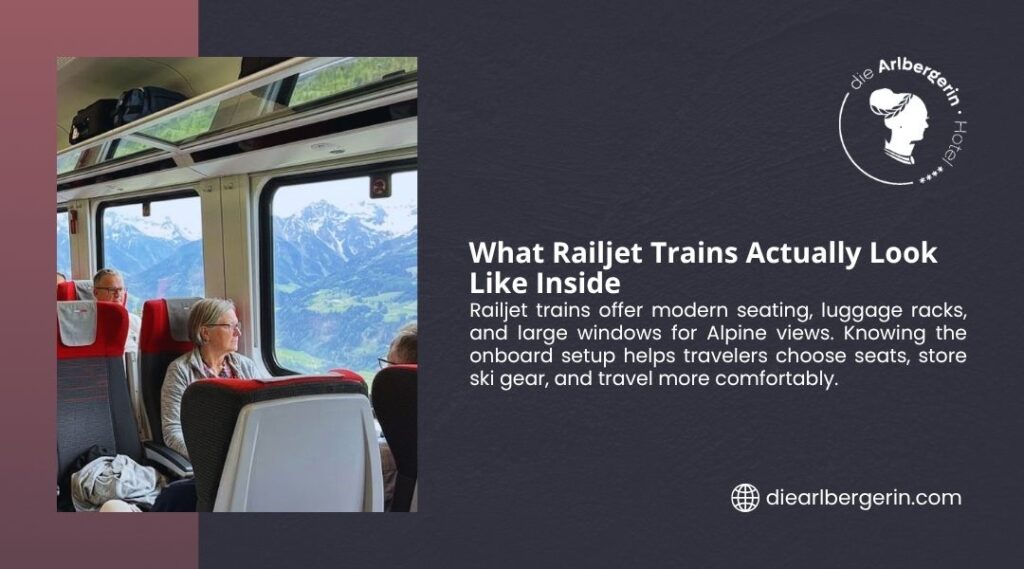
The trip starts in an urban rail hub, settles into the rhythm of a long-distance train, and gradually shifts into mountain country. The farther west the route pushes, the more the landscape begins to do the work. For many travelers, the journey itself becomes part of the holiday rather than a dull transfer between two points.
| Part of the trip | What it usually feels like |
| Departure from Munich | Fast-paced, practical, city-station energy |
| Mid-route connection | Brief reset, usually manageable with normal transfer time |
| Final leg into St. Anton | More scenic, more alpine, quieter mood |
That change in atmosphere matters. A road trip can wear people down before they even arrive. The train often does the opposite. It gives them time to settle, look out the window, and reach St. Anton with more energy left for the evening. That is one reason this route keeps appealing to winter guests and summer mountain travelers alike.
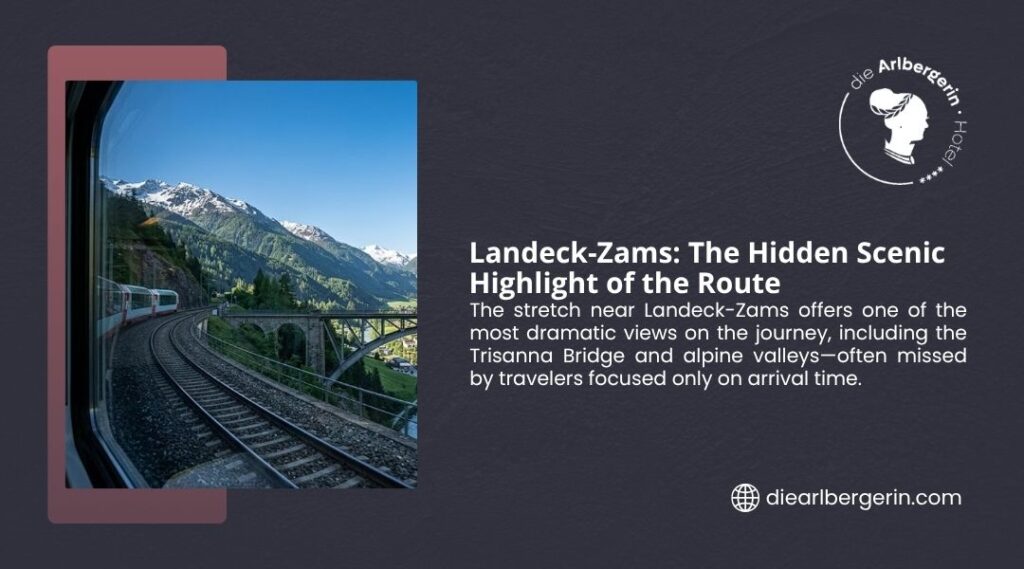
Keep your camera ready as you pass through Landeck-Zams, where the tracks offer a spectacular view of the Trisanna Bridge and the surrounding castle ruins.
Arriving at St. Anton am Arlberg station
Arrival is one of this route’s strongest selling points. St. Anton’s official tourism material states that the village is a Railjet station and that hotels and accommodation are quickly reached from the centrally located railway station. That makes St. Anton more rail-friendly than many Alpine destinations, where the train gets you only part of the way, and the rest feels like an afterthought.
| Arrival detail | What it means on the ground |
| Railjet station | St. Anton sits on a major long-distance rail corridor (Vienna/Zurich) |
| Central station location | Hotels and village services are close at hand |
| Quick hotel access | Easier last-mile arrival with luggage or ski gear |
That central arrival is not a small detail. It changes the tone of the day. Instead of facing a long transfer after the rail leg, the traveler reaches a station that already sits inside the resort fabric. From there, it is much easier to move into a stay, whether the traveler prefers a quiet hotel in St. Anton or wants to compare hotel rooms in St. Anton am Arlberg.
When the train beats the car, and when it really beats the car
The train does not win every time for every traveler, but it wins often enough that it should be treated as the default option rather than the backup plan. In winter, especially, the comparison shifts. Driving means weather, traffic, parking, fatigue, and the usual drag of mountain-road uncertainty. Rail removes most of that friction and gives the traveler a more predictable day.
| Travel mode | Where it shines | Where it falls short |
| Train | Predictable timing, less stress, and central arrival | Usually one change |
| Car | Flexibility for rural stopovers | Winter road stress, parking, and driver fatigue |
The train really pulls ahead when the traveler values comfort, arrival ease, and consistency over total freedom on the road. For a route like Munich to St. Anton, those advantages are not abstract. They show up in the real trip, from the platform to check-in.
Best time to book and the fare patterns to watch
ÖBB’s own pricing guidance gives you the framework. Book too late and the cheapest inventory is gone. Book early, and you have a better shot at lower average prices, especially on fixed-date travel.
That does not mean every date is cheap, and it definitely does not mean every retailer shows the same fare. It means a traveler who wants value should plan the rail leg as soon as flights, leave dates, or accommodation are set. If you already know where you want to stay, it makes sense to pair the rail search with a look at current offers in St. Anton so the trip budget works as a whole rather than in pieces.
| Timing | What usually happens |
| 4 to 6 months out | Better chance at discounted advance fares |
| 1 to 3 months out | Still workable, but the cheapest quota may be gone |
| Last-minute winter booking | Fares often rise, and the best connections may be less appealing |
Common mistakes first-time travelers make on this route
Most first-time mistakes come from assumptions rather than a lack of options. People expect a direct train, underestimate the value of booking early, or treat every departure as if it were equal. On this route, small planning choices make a big difference.
| Common mistake | Why does it cause trouble | Better approach |
| Assuming a direct train is standard | Most daytime routes need a change | Expect one good connection and plan around it |
| Booking too late | Cheapest fares often disappear first | Buy when dates are fixed |
| Starting from the wrong station | Airport departures often add time | Use Munich Hbf when possible |
| Choosing only by departure time | Slower connections can waste the day | Compare total journey quality, not just departure hour |
| Overcomplicating operator names | DB and ÖBB mixes are normal | Focus on the route, not the branding |
These mistakes are easy to avoid. It helps the travelers to make a better choice without second-guessing the trip.
A quick comparison of the route choices that matter most
The comparison below works best when it is framed as a decision tool. The traveler wants to know which option fits real travel conditions, not just which one looks tidy on paper.
| Route choice | Best fit | Main trade-off |
| Munich Hbf to St. Anton by train | Most city-based travelers | Usually one change |
| Munich Airport to St. Anton by train | Same-day arrivals by air | Slower and less straightforward |
| Rental car from Munich | Travelers with unusual stop plans | More stress in winter |
| Private transfer | Comfort-first, high-budget trips | Highest cost |
Seen that way, the train from Munich Hbf comes out as the most balanced option for most travelers. It is quick enough to compete with the road, easier to manage in poor weather, and better aligned with St. Anton’s central station setup once the traveler arrives.
The route that makes the most sense
If someone asks how to get from Munich to St. Anton am Arlberg by train, the best answer is not fancy. Start from Munich Hbf when you can. Check Deutsche Bahn and ÖBB side by side. Expect one change on most dates. Book early for the best chance at lower fares. Then arrive at a station that is right where a mountain station ought to be: central, useful, and close to the life of the resort.
And once you arrive, make the rest of the trip just as easy. You can explore the warm, design-led atmosphere at Die Arlbergerin, check current offers for your St. Anton stay, or send a quick enquiry for your trip dates and line up the stay before the train tickets are gone.