Trail running routes St. Anton am Arlberg in summer offer far more than scenic paths; they combine alpine elevation, varied terrain, and a quiet rhythm that many Alpine resorts lack. This guide breaks down the most rewarding routes, explains how to read the local trail system, and shows where to stay, recover, and plan your trip with ease. It also reflects what runners actually need on the ground: practical route detail, local insight, and a base that supports performance and recovery.
Trail running routes St. Anton am Arlberg in summer: what makes them unique
Trail running routes St. Anton am Arlberg in summer stand apart because of one simple factor: contrast. Within a few kilometers, the terrain shifts from forest-covered valley paths to exposed alpine ridges. That change isn’t gradual; it happens quickly, and that’s exactly why experienced runners keep coming back.
According to regional trail data and tourism resources, St. Anton sits at around 1,304 meters above sea level, with many trail running routes St. Anton am Arlberg in summer climbing beyond 2,000 meters. Research shows that high altitude begins at approximately 1,500 meters, where reduced oxygen levels start to impact endurance and recovery. In practical terms, this means even moderate alpine routes demand more effort, especially on sustained climbs common in the Arlberg region.
But here’s the thing. That added effort brings a reward. Cooler temperatures, stable summer conditions in the morning, and wide, open views across Tyrol create a running environment that feels both demanding and surprisingly calm.
St. Anton am Arlberg offers more than 400 km of marked trails, according to the official tourism board, making it one of the most diverse alpine running environments in Austria. That’s why many runners combine their stay with activities beyond running.
When planning a longer trip, exploring different things to do in St. Anton am Arlberg without skiing adds variety, whether it’s winter hiking, spa experiences, or local cultural spots around the area.
Understanding the St Anton trail map before you run
Before stepping onto any trail running routes St. Anton am Arlberg in summer, it’s worth understanding how the local trail system works. The St Anton trail map is straightforward at first glance, but some nuances matter.
Trail markers rely on color coding similar to ski runs. Blue indicates easier routes, red signals moderate terrain, and black marks technically demanding sections. However, unlike ski slopes, these categories also account for elevation gain and terrain variability.
Trail hubs revolve around three main areas: Galzig, Rendl, and Verwall. Each offers a different experience. Verwall remains the most accessible and forgiving, while Rendl introduces sharper elevation shifts and technical descents.
Navigation remains reliable thanks to consistent signage, but runners often rely on GPS apps for precision. Still, local knowledge matters more than digital tracking. Weather shifts fast in alpine regions, and route familiarity becomes essential. Miss one turn up high, and you’ll feel it.
Best trail running routes St. Anton am Arlberg in summer (ranked by difficulty)
| Route Name | Distance | Elevation Gain | Duration | Difficulty | Terrain Type |
| Verwall Valley | 12 km | 150 m | 1.5–2 hrs | Easy | Flat gravel, river trail |
| St Anton–St Christoph | 9 km | 400 m | 2–3 hrs | Moderate | Forest + alpine path |
| Rendl Ridge | 14 km | 900 m | 3–4 hrs | Advanced | Ridge + rocky descent |
| Valluga Challenge | 18 km | 1,300 m | 4–6 hrs | Expert | High alpine terrain |
Verwall Valley Run – a steady introduction
Among all trail running routes in St. Anton am Arlberg in summer, Verwall Valley remains the most approachable.
| Details | Information |
| Start Point | Near St Anton village center (specifically at the Rendlbahn or Hotel Mooserkreuz entrance) |
| Route Type | Out-and-back (can be extended into a loop via the Rosanna river banks) |
| Terrain Breakdown | 80% gravel, 20% forest trail |
| Distance | 7.5 km to 10 km |
| Elevation gain | Minimal (320 m) |
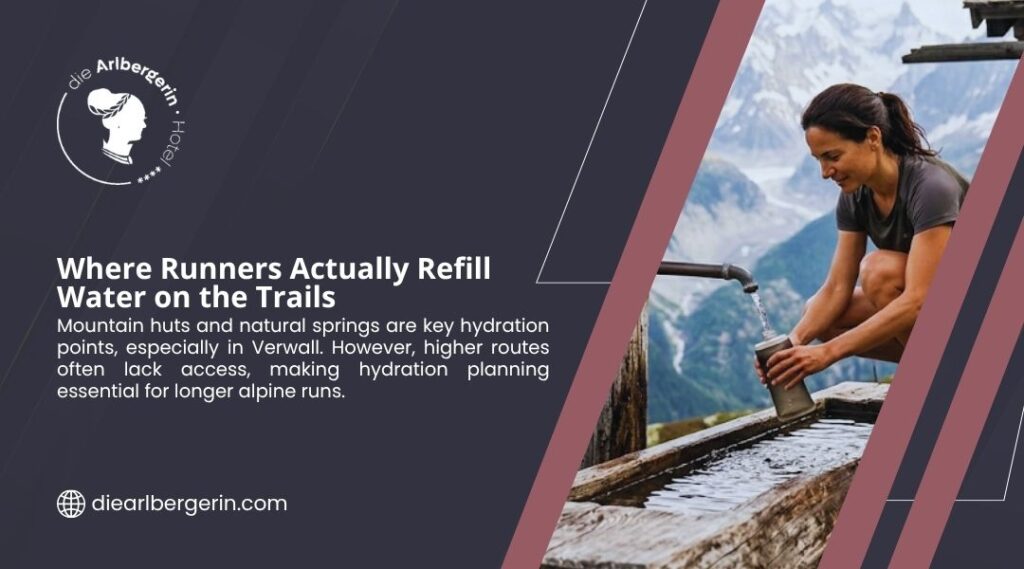
The path follows the Rosanna River, with minimal elevation gain and wide gravel trails that allow a consistent pace. Water refill points are available at huts along the valley, making it ideal for longer, easy runs.
This route works well for acclimatization. The altitude still plays a role, but the terrain stays predictable. Runners often use this path as a warm-up before tackling more demanding routes. If recovery matters, nearby alpine lakes offer a refreshing cool-down option.
Some of the best swimming lakes near St. Anton am Arlberg in summer provide clear mountain water and a calm setting, making them ideal for unwinding after outdoor activities.
St Anton to St Christoph – steady climbs, strong payoff
| Details | Information |
| Start Point | Galzigbahn cable car base station (St. Anton am Arlberg) |
| Finish Point | St. Christoph village centre |
| Best direction to run | Uphill toward St. Christoph for steady pacing |
| Route Type | Point-to-point (return via Bus 92) |
| Distance | ~6.2 km (3.8 miles) |
| Elevation gain | ~500 meters |
| Difficulty | Moderate (Blue-rated trail) |
This route introduces elevation without overwhelming technical difficulty by following the Moosenweg trail. The climb builds gradually, moving through forest sections before opening into alpine terrain.
Here’s what stands out. The transition between tree cover and open mountain views happens abruptly near the Maiensee lake. One moment you’re in shade, the next you’re exposed to sweeping views of the Valluga and Stanzer Valley.
That shift can affect pacing. Many runners underestimate the second half of the route near the Sennhütte, where elevation gain becomes more noticeable. Expect the final section to feel tougher than the distance suggests.

Rendl Ridge Run – where terrain begins to test you
Trail running routes St. Anton am Arlberg in summer reach a new level on the Rendl Ridge.
| Details | Information |
| Start Point | Rendlbahn cable car mountain station (2,100 m) |
| Highest Point | Zwölferkopf-Sumit (2,556 m) |
| Terrain | Exposed alpine ridges, unstable scree slopes, and steep forest descents. |
| Route Type | Technical Alpine Loop |
| Distance | ~9–12 km (depending on the descent variant) |
| Elevation gain | ~450 m to 850 m |
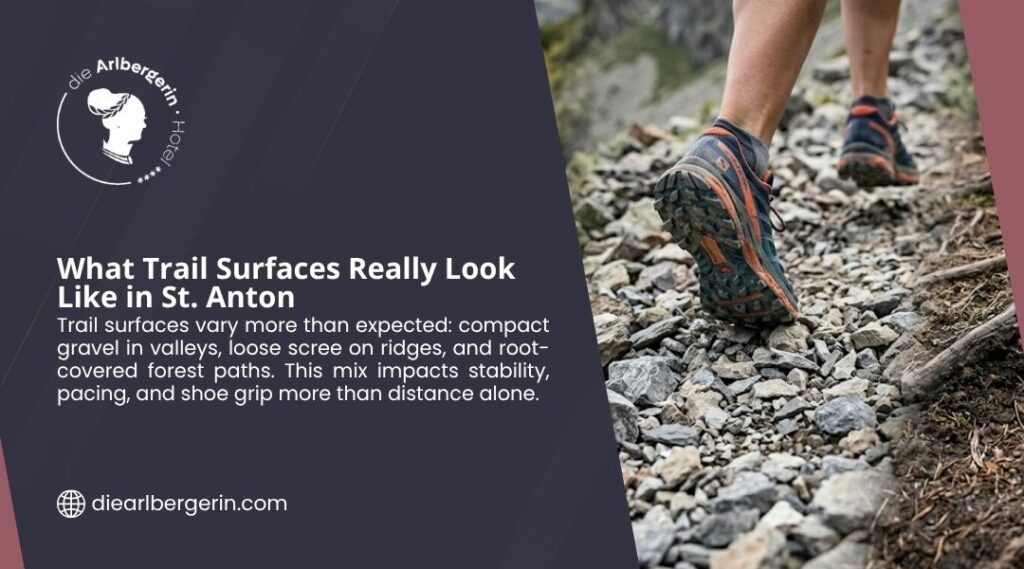
Balance and footing become critical. The trail narrows, and loose rock appears frequently. It’s not just about endurance anymore; it’s about control.
This route suits runners who already have experience with alpine terrain. It demands focus but rewards you with some of the best panoramic views in the region. There are limited water refill points, so carrying hydration is essential.
Valluga Challenge – the full alpine experience
For experienced runners, the Valluga Challenge represents the peak of trail running routes St. Anton am Arlberg in summer.
| Details | Information |
| Start Point | Galzigbahn valley station (St. Anton village) |
| Terrain | Technical singletrack, limestone scree, and secured ridge sections (fixed cables) |
| Route Type | Lollipop loop via Galzig and Vallugagrat |
| Distance | ~18–20 km (loop variant) |
| Elevation gain | ~1,500 meters vertical climb |
The climb is steep, the altitude is noticeable, and the terrain becomes unpredictable. Weather plays a significant role here. Even in summer, conditions can shift quickly at higher elevations.
According to the International Trail Running Association, trail difficulty is often measured using a ‘kilometre-effort’ formula, where every 100 meters of elevation gain adds the equivalent of one extra kilometer of running, showing how quickly climbs increase overall effort. That insight becomes obvious on this route.
When to run: seasonal timing and daily conditions
| Month | Trail Condition | Temperature | Recommendation |
| June | Partial snow melt | 10–18°C | Lower routes only |
| July | Fully accessible | 15–22°C | Ideal conditions |
| August | Dry and stable | 16–24°C | Best performance window |
| September | Cooler, crisp | 8–18°C | Scenic, less crowded |
Early summer often surprises runners. Snow may linger on higher trails, limiting access. By July, most trail running routes in St. Anton am Arlberg open fully in summer. Morning remains the best time to run. Temperatures stay lower, and the weather remains stable. Afternoon storms can develop quickly, especially in August.
If you’re planning a trip outside peak months, exploring what to do in St. Anton am Arlberg in spring helps set clear expectations around activities, weather, and the overall atmosphere during the quieter season.
What experienced trail runners say about St Anton
Seasoned runners tend to describe St. Anton less as a destination and more as a testing ground. Not because it’s extreme in a dramatic sense, but because it quietly exposes weaknesses, pacing, hydration, and even decision-making.
Many note how quickly conditions change. A route that starts in cool shade can open into direct sun within minutes. Wind picks up on ridgelines, while valleys stay still. It’s subtle, but it matters.
According to World Athletics guidance on mountain running, in mountain running, courses are defined less by distance and more by elevation gain and terrain, often requiring a mix of running, walking, and climbing depending on steepness.
What stands out most is how the terrain forces adjustment. You don’t run the mountain; you respond to it. That’s why experienced trail runners often return here, not to chase faster times, but to refine how they move through the landscape.
And there’s another detail people mention. It feels quieter than expected. Even in peak summer, there’s space to run without constant interruption. That alone changes the rhythm of a run.
How to prepare for alpine trail running in St Anton
Preparation for trail running routes St. Anton am Arlberg in summer is less about gear trends and more about understanding the environment.
Start with timing. Early mornings offer the most stable conditions. Air stays cooler, and trails are less exposed. By midday, the difference can be noticeable, heat builds, and storms become more likely.
Hydration is another factor runners underestimate. At altitude, fluid loss happens faster than expected. Carrying water isn’t just recommended; it’s part of basic safety. Footwear should match the terrain. Loose gravel, uneven ridges, and occasional wet patches require a reliable grip. Road shoes don’t hold up well here. It sounds obvious, but it’s often overlooked.
Then there’s pacing. Routes that look manageable on paper tend to feel longer due to elevation gain. It helps to approach the first run conservatively. Let the body adjust. And honestly, most runners get this wrong on day one. It happens.
Recovery, food, and where to refuel after your run
Recovery after trail running routes St. Anton am Arlberg in summer plays a larger role than many expect. The combination of elevation, terrain, and temperature variability places consistent stress on the body. That’s where food becomes part of the experience, not just a necessity.
Traditional Tyrolean meals are built around balance, protein for muscle recovery, carbohydrates for energy restoration, and ingredients sourced locally. But what makes the difference is how that tradition evolves.
At Die Arlbergerin, a family-run hotel just outside the center, this balance comes through clearly. The kitchen combines traditional Tyrolean dishes with a modern twist, lighter where needed, but still satisfying after a long run. For a direct experience, many runners choose a relaxed restaurant in St Anton after a run. Because here’s what matters. Recovery isn’t just about rest. It’s about how well the body resets for the next day.
Where to stay for easy access to trail running routes, St. Anton am Arlberg in summer
Location influences everything. Staying slightly outside the busiest part of town often provides better access to quieter trails. After a long run, many guests prefer staying somewhere quiet, away from the noise, but still close enough to reach the trails quickly. This is where choosing the right base matters.
Die Arlbergerin, a family-run hotel set just outside the center, offers exactly that balance, a quiet base designed for rest, recovery, and easy trail access. It’s the kind of place where your run day starts early and ends in comfort.
A well-positioned hotel in St Anton allows quick transitions from breakfast to the trail without dealing with crowds. Rooms designed with comfort in mind also support recovery. You can explore available rooms in St Anton. And honestly, after a few hours on alpine terrain, you’ll appreciate that calm more than anything else.
Planning your trip to St Anton for trail running
Planning a trip around trail running routes St. Anton am Arlberg in summer requires a bit of structure, but nothing complicated. The easiest access point is Innsbruck Airport. From there, the transfer takes roughly 1 to 1.5 hours, depending on transport choice.
Train travel also works well. Connections from Munich are frequent and efficient, with direct routes available during peak seasons. What matters more than transport is where you stay. That difference shows in small ways. Space to unwind. No rush. A rhythm that fits the day.
Why do trail running routes in St. Anton am Arlberg stand out in Austria in summer
Austria offers several trail running destinations, but St. Anton brings a distinct combination of accessibility and challenge.
Some regions provide gentle terrain but lack elevation variety. Others offer extreme climbs but require long travel times to reach trailheads. St. Anton sits in between. Trails begin close to town, yet quickly transition into high alpine terrain. That proximity makes it easier to plan multiple runs within a short stay.
Make your run part of a complete alpine experience
Trail running routes St. Anton am Arlberg in summer rarely define the entire day. Most visitors build their experience around a mix of activity and recovery. Some choose to hike after a shorter run. Others take a slower afternoon, coffee, terrace, quiet views. Most visitors combine running with other mountain activities.
Paragliding offers a completely different perspective of the same landscape. With paragliding in St. Anton am Arlberg during summer, you can take in sweeping alpine views, glide over valleys, and experience the terrain from above in a calm and immersive way.
That combination, running in the morning, exploring in the afternoon, creates a balanced experience that goes beyond training.
FAQs About the Best Trail Running Routes
What are the best trail running routes in St. Anton am Arlberg in summer for beginners?
The best beginner-friendly trail running routes in St. Anton am Arlberg in summer are found in Verwall Valley. These routes offer flat terrain, minimal elevation gain, and clear paths, making them ideal for acclimatization and steady pacing.
Is St Anton good for trail running in summer?
Yes, St Anton is one of Austria’s top destinations for trail running in summer due to its mix of accessible valley routes and challenging alpine terrain. The region offers marked trails, reliable infrastructure, and varied elevations.
When is the best time for trail running routes in St. Anton am Arlberg in summer?
July and August provide the best conditions, with fully accessible trails and stable weather. Early mornings are recommended to avoid heat and afternoon storms.
Do I need special gear for trail running in St Anton?
Yes, proper trail running shoes with a strong grip, hydration packs, and weather-appropriate layers are essential due to uneven terrain and changing alpine conditions.
How difficult are the trail running routes in St. Anton am Arlberg in summer?
Difficulty varies widely. Some routes are beginner-friendly, while others involve steep climbs and technical descents. Elevation gain often makes routes more demanding than expected.
Are there water refill points along the trails?
Yes, several routes, especially in the Verwall Valley, include huts and refill points. However, higher alpine routes may not have consistent access, so carrying water is important.
Ready to plan your alpine running escape
Trail running routes St. Anton am Arlberg in summer offer a rare mix of challenge, scenery, and accessibility. Each route brings a different experience, from quiet valley paths to demanding alpine ridges.
If you’re planning a trip, timing, preparation, and accommodation all play a role. A well-placed stay makes early starts easier, recovery more effective, and the overall experience far more enjoyable.
To take the next step, explore current offers in St Anton that align with your travel dates. Or, if you prefer a tailored stay, you can send a hotel inquiry in St Anton and plan your visit around the trails that interest you most.
Because here’s what it comes down to. Trail running routes St. Anton am Arlberg in summer aren’t just about distance or elevation. They’re about how the mountains shape every step, and how that experience stays with you long after the run ends.